

NFC in Automobiles
Playing a key role in delivering digital transformation within the automotive sector.
Why NFC in automotive?
Similar to the transition of mobile devices to smartphones, the automotive industry is entering an era in which vehicles are becoming connected, convenient and multi-functional.
For drivers:
NFC is a familiar, trusted technology that is reliable and easy to use. User intent is a key feature to transition drivers from physical to digital keys and will open up many additional use cases.
For manufacturers:
NFC is easy to implement, connecting into a wider existing ecosystem that is reliable, secure and readily endorsed by the industry.
Bahar Sadeghi, Senior Director of Technical Strategy and Advisory at Car Connectivity Consortium:
“NFC has become a foundational technology for delivering seamless and intuitive vehicle access experiences. Its robust performance, security, and ease of use enable automakers to introduce innovative services while maintaining consumer confidence. As connected vehicle ecosystems continue to evolve, trusted and interoperable solutions are essential for widespread adoption. NFC Forum standards provide that foundation, building on a proven track record across automotive and other industries.”
Join the Conversation
NFC Forum is actively defining use cases and working with associations and partners across the automotive ecosystem to make the digital vehicle a reality. In addition to ensuring NFC technology is part of the automotive OEMs connected car strategy, we want automotive representatives to speak to us, use our infrastructure, join us and share their technical and business requirements.
Use Cases
Car Access Using NFC Forum Standards to drive interoperability across the ecosystem
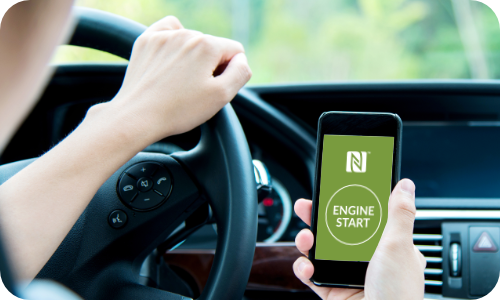
A car key is digitalized onto a smartphone using the Car Connectivity Consortium’s (CCC) Digital Key Specification. Digital keys provide ease of use to the consumer, and digital key management systems reduce the cost and complexity of physical key handling for OEMs. They enable functionalities for the user such as:
Phone tap to open/close vehicle.
Phone tap to drive vehicle.
Digital Key usage, even if the smartphone has no battery.
Complete key management – such as sharing the key, owner pairing or termination.
Smartcard as digital key in addition to the phone, if desired.
NFC Forum Standards are used to provide the NFC interface that supports the digital key transaction to lock and unlock the door. Using this global standard ensures that products are designed and manufactured to the industry requirements, delivering a reliable and consistent user experience.
CCC uses the NFC Forum Certification Program to instil confidence between vehicle and smartphone manufacturers that the CCC Digital Key™ technology will be interoperable across the entire ecosystem. Learn more about NFC Forum Certification.
NFC Forum Certification Release 15 requires an NFC chip in reader mode to have an operating volume (OV) of 20 mm, four times the previous requirement of 5 mm. This larger OV means that the tapping motion of the digital key on the car’s reader will be a more reliable and user-friendly experience.
Linyi Gao, a representative from the Intelligent Car Connectivity Ecosystem Alliance (ICCE) and member of the NFC Forum, commented:
“When considering the diverse positioning of an NFC chip within a smartphone and the range of a car door handle or side mirror design, the angle in which the smartphone needs to be positioned to unlock the door will vary considerably. ICCE research showed that 47.4% of Chinese car manufacturers needed the operating volume to be 20 mm at a minimum to ensure a reliable connection.”
With the OV extension, the reader can have a good connection despite less accurate alignment with the phone, offering a faster and more consistent user experience.
Digital Product Passport
NFC Forum Standard compliant tags are ideally suited to store Digital Product Passport (DPP) data in a vast range of use cases. The ability for this information to coexist with existing NFC applications lays the foundation for an accessible and interoperable data management ecosystem that can vastly accelerate the advancement of the circular economy.
The NFC Forum Digital Product Passport Standard defines a flexible, data agnostic framework to allow a single NFC tag embedded in a product to store and transmit both standard and extended DPP data using common NFC Data Exchange Format (NDEF) records.
Unlike other expected data carrier solutions, the NFC Forum Standard offers static and dynamic data to be securely hosted and accessed offline using non-volatile memory stored on the product itself.
As the overall DPP architecture is expected to include both cloud-based systems for online data storage and methodologies to connect products to these systems (known in the industry as DPP Data Carriers), the NFC Forum Standards extend the capability of using NFC Forum technologies as data carriers.
Additionally, by embedding DPP data directly into products, manufacturers can ensure the data is available for the full lifecycle of the product while also providing additional anti-tampering capabilities and not having to rely entirely on a cloud data infrastructure.
What’s next for NFC Technology in the Automotive Industry?
The NFC Forum’s Automotive Special Interest Group is developing NFC use cases and standards that enable smarter, more personalized driving experiences, such as automatically adapting vehicle settings to driver preferences and supporting loyalty rewards for in-car purchases and interactions.
NFC technology can automatically personalize the vehicle experience for each driver. By tapping a smartphone or key fob to unlock the vehicle, the driver’s stored preferences can be instantly applied, creating a seamless and secure experience.
Each driver can have a personalized profile linked to their smartphone or key fob.
Automatically applies settings such as seat position, climate control, mirrors, lighting, infotainment preferences, payment accounts, and in-car apps when the vehicle is unlocked.
Provides secure and easy personalization across multiple driver profiles, reducing the need for manual adjustments.